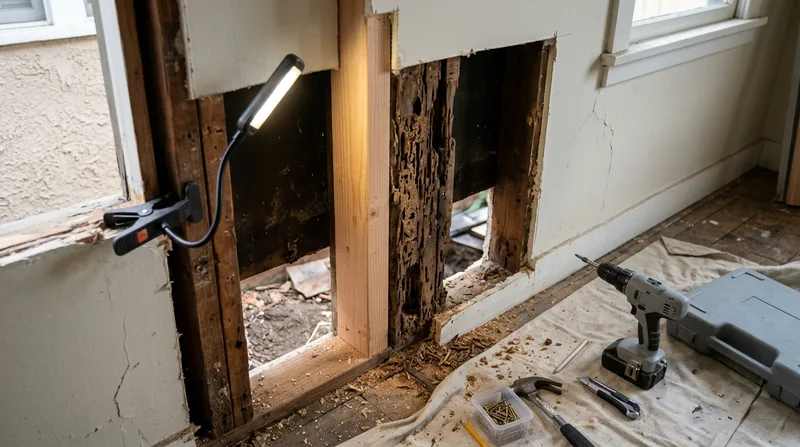




Drywood and subterranean termites are a year-round problem across Southern California, and Santa Clarita's mix of older Craftsman bungalows, ranch homes, and newer master-planned communities all show the damage. After your pest inspection and fumigation, the eaten wood remains. Termite damage repair in Santa Clarita means replacing compromised studs, sill plates, floor joists, subfloor sections, and trim to restore full structural integrity. We work from your pest inspection report, remove the damaged wood, sister new framing where appropriate, and replace what cannot be saved. The goal is a sound, dry structure that will not re-infest because the conditions that attracted termites are corrected and the wood is new.
Why Termite Damage Repair Matters in Santa Clarita's Older and Newer Homes
Santa Clarita sits in a region where both drywood and subterranean termites thrive year-round. The valley's older board-and-batten cottages and Craftsman bungalows in Old Town Newhall and the canyon properties often rest on raised floors over crawlspaces, where moisture and access to soil create ideal termite habitat. Newer tract homes in Valencia, Stevenson Ranch, and Westridge have wood fascia, deck posts, and framing that can also attract colonies. The long, hot, dry summers that regularly exceed 100 degrees bake exterior wood until paint fails and checks open, while winter rains and daily sprinkler overspray soak siding bottoms, sills, and subfloor edges. These conditions accelerate termite damage once an infestation takes hold.
- Termites consume wood from the inside out, leaving hollow cavities and structural weakness that fumigation alone does not repair.
- Damage to floor joists, rim joists, and sill plates can cause floors to sag, doors and windows to stick, and long-term settling that compounds over years.
- Termite-eaten studs in load-bearing walls lose shear strength and cannot safely carry roof or upper-floor loads without replacement or sistering.
- Subfloor sections compromised by termites must be cut out and replaced to prevent soft spots, bounce, and future rot from moisture intrusion.
- Early repair after inspection stops the damage from spreading and prevents costlier structural failures down the road.
Addressing termite damage promptly protects your home's value and safety.
Local reality: Santa Clarita's older homes in Placerita Canyon and Sand Canyon often have crawlspace access and wood-to-soil contact that termites exploit. Newer homes on graded hillside pads can also develop moisture problems around deck posts and rim joists if gutters fail or irrigation runs too close to the foundation. We see both patterns regularly.
For more details on wood damage assessment and repair, see our page on wood rot and dry rot repair, which covers similar structural pathology and restoration methods.
How We Repair Termite Damage in Santa Clarita: Step-by-Step Process
Termite damage repair starts with your pest inspection report. We do not treat or fumigate, we repair. Once the fumigator has cleared the infestation, we assess which wood must be replaced and which can be reinforced. For structural members like floor joists, rim joists, and studs, we often sister new lumber alongside the damaged section, fastening with lag bolts or screws to restore load capacity. For severely compromised wood, we cut out the damaged section and splice in new framing. Subfloor sections are cut out in rectangular patches and replaced with new plywood or boards, fastened to the surrounding joists. Trim, fascia, and non-structural pieces are simply replaced.
- We inspect the damage in detail and photograph the extent to help you document the claim and understand the scope.
- We identify load-bearing members and non-structural trim so repair strategy matches the actual risk.
- We remove termite-eaten sections carefully, preserving sound wood and taking care not to disturb mold or moisture patterns that need attention.
- We sister new lumber to compromised joists and studs using proper fastening and full-bearing contact.
- We cut out and replace subfloor sections, ensuring new plywood sits flat and is fully fastened to the rim and field joists.
- We replace fascia, sill trim, and exterior wood with pressure-treated or naturally rot-resistant species as appropriate for the location.
The entire process restores the wood structure to sound condition so termite damage does not return if the moisture and pest conditions are controlled.
Example: A 1960s ranch home in Canyon Country with a crawlspace had subterranean termites in the sill plate and the first 18 inches of the rim joist. We sistered 2x8 pressure-treated lumber alongside the rim joist, replaced the sill plate section under the affected wall, and cut out and replaced a 4-by-6-foot section of subfloor. The entire repair took three days, and the floor is now solid and level again.
For related work on floor structure, see our floor joist and subfloor repair page.
Termite Damage Repair Methods and Approaches
| Repair Method | Description | Best For |
|---|---|---|
| Sistering | New lumber fastened alongside the damaged member with lag bolts or structural fasteners, sharing the load and restoring capacity without full removal. | Floor joists, rim joists, and studs where the core is compromised but the member must remain in place and can accept a sister. |
| Splice Replacement | The damaged section is cut out and new lumber is spliced in with full-bearing connections and fastening, restoring the original member without duplication. | Sections of joists, studs, or beams where damage is localized and the member can be cut and re-joined with proper support underneath. |
| Subfloor Patch | The damaged plywood or boards are cut out in a rectangular section and new plywood is fitted and fastened to the surrounding joists with screws or nails on 8-inch centers. | Subfloor sections eaten by termites where the joists below are sound and the patch is accessible from below or above. |
| Full Member Replacement | The entire joist, stud, or beam is removed and a new one is installed in its place with proper bearing and fastening, restoring original capacity. | Members with severe damage along their length, or where sistering is not practical due to space, access, or structural requirements. |
| Trim and Fascia Replacement | Non-structural trim, fascia, sill boards, and exterior casing are removed and replaced with new lumber, often pressure-treated or naturally resistant species. | Fascia, soffit trim, window and door casings, and sill boards damaged by termites where the structure underneath is sound. |
Termite Damage Repair Cost in Santa Clarita: What to Expect
Termite damage repair costs in Santa Clarita typically start at $1,200 for small, localized repairs such as replacing a short section of trim or sistering a single floor joist in an accessible crawlspace. The actual cost depends on how much wood is damaged, how deep the infestation spread, and how easy the damaged members are to reach. A rim joist repair in a crawlspace costs less than a repair in a wall that requires drywall removal and patching. Subfloor patches range from $1,500 to $4,000 depending on the area affected and access. Full joist or stud replacement in a load-bearing wall can run $2,500 to $6,000 or more if the repair requires temporary support, drywall removal, or multiple members.
Several factors move the price up or down. The extent of the damage is the primary driver, whether a few square feet of subfloor or an entire rim joist. The location of the damage matters too, since crawlspace repairs are faster than interior wall repairs that require drywall removal and patching. Access to the damaged wood affects labor time, as does whether the repair requires temporary support posts or bracing. The species and grade of replacement lumber also vary in cost, with pressure-treated lumber costing more than standard framing lumber but lasting longer in damp conditions.
We recommend getting two or three estimates from local carpenters so you can compare scope, approach, and price. Each estimate should itemize the wood to be removed, the replacement lumber and fasteners, and the labor. Our pricing page covers a range of typical jobs and the factors that affect them. For a precise quote on your specific damage, call us at (661) 533-4577 for a free estimate, and we will inspect the work and give you a firm number.
Termite Damage Repair Near Me: What Santa Clarita Homeowners Should Look for When Hiring a Carpenter
Finding a carpenter for termite damage repair in Santa Clarita means looking for someone who understands both the structural repair and the moisture or pest conditions that allowed the damage to happen in the first place. A good carpenter will ask about your pest inspection report, understand what the fumigator found, and explain whether the repair is sistering, splicing, patching, or replacement. They should also identify any moisture problems, failed gutters, or poor drainage that may have contributed to the infestation so you can address those issues and prevent recurrence.
Ask any contractor you consider whether they are fully insured and can provide proof of coverage. Request references from past jobs in Santa Clarita or nearby areas so you can ask homeowners about the quality of the work and the accuracy of the estimate. Understand whether the repair will require a permit from the Santa Clarita building department, especially if the work involves load-bearing members or structural changes. Some repairs are straightforward and do not require a permit, while others do. Your contractor should clarify this upfront and help you understand the process. If you live in a homeowners association, check your CC&Rs or contact the HOA to see whether approval is needed before work begins.
Get a written estimate that breaks down the labor, materials, and timeline so there are no surprises. A reputable local carpenter will stand behind the work with a warranty and will be available to answer questions after the job is done. For a free estimate and to discuss your specific termite damage, contact us at (661) 533-4577, and we will walk you through the process.
Termite Damage Repair in Santa Clarita: Pricing Guide
| Service | Price | Details |
|---|---|---|
| Small trim or fascia repair | Starting at $1,200 | Replacement of termite-damaged fascia, sill trim, or exterior casing in accessible locations with minimal structural involvement |
| Subfloor patch or single joist repair | Starting at $1,800 | Removal and replacement of subfloor section or sistering of one floor joist in crawlspace, including material and fastening |
| Multiple joists, rim joist, or load-bearing repair | Starting at $3,500 | Sistering or replacement of multiple structural members, rim joist sections, or studs in load-bearing walls with drywall removal and patching |
| Complex multi-area damage | On estimate | Extensive termite damage across crawlspace, multiple walls, or structures requiring temporary support and engineered coordination requires on-site inspection |
| Travel | Included | No separate mileage fee for Santa Clarita and surrounding service areas within our local territory |
| Free estimate | Free | Response within 24 hours at (661) 533-4577, site inspection and written quote with no obligation to book |
Indicative pricing, the exact cost depends on square footage, finish, and site access. Free personalized estimate within 24h at (661) 533-4577.


